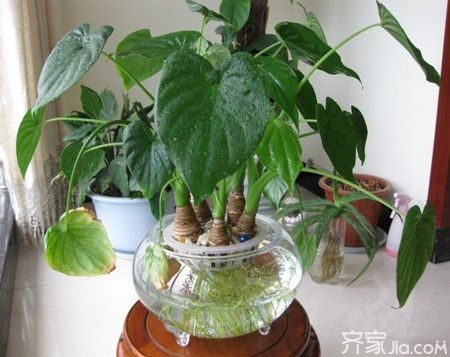
Cutting method of hanging bell flower
Core tips: The propagation of hanging bell flowers is generally done by cuttings, in spring in March ~ May, and autumn in August ~ September. Select strong branches, each segment has 2~3 stem nodes, leave a pair of leaves on top, cut the base diagonally at the near node, soak all in 0.1 potassium permanganate solution for 30 seconds, expose the leaves upright, and continue to soak the base for 30 minutes. Take it out and use it clearly
The propagation of hanging bell flowers is generally done by cuttings, in spring in March ~ May, and in autumn in August ~ September. Select strong branches, each segment has 2~3 stem nodes, leave a pair of leaves on top, cut the base diagonally at the near node, soak all in 0.1 potassium permanganate solution for 30 seconds, expose the leaves upright, and continue to soak the base for 30 minutes. After taking it out, brush it with clean water, and then raise it in clean water for 24~48 hours before inserting the rod, and the density should be that the leaves do not cover each other.

Cuttings should be transplanted as soon as possible after they take root. Generally, the root length should not exceed 2 cm. First, plant the cuttings in plain soil (50% garden soil and 50% river sand) in a small bowl to promote root growth. Plain soil is less irritating to new and young roots, which is conducive to survival. After planting, water twice to permeate the water, drain it tightly in a shallow pot, and place it in a semi-shaded place for maintenance.
Hanging bell flowers are often cut with young branches of the current year in late spring and early autumn, or old branches with last year's branches in early spring. It is nutrient soil or river sand, peat soil and other materials used for cuttings. It is recommended to use the prepared and disinfected cutting substrate provided by this site; Medium-coarse river sand is also fine, but rinse with clean water several times before use. Do not use sea sand and river sand in saline-alkali areas, they are not suitableFlowersPlant growth.
When cuttings are carried out, when the plants are growing vigorously from late spring to early autumn, the thick branches of the current year are selected as cuttings. After cutting off the branches, select the strong parts and cut them into sections 5~15 cm long, with more than 3 leaf nodes in each section. When cutting cuttings, it should be noted that the upper cut is about 1 cm above the top leaf node, and the lower cut is about 0.5 cm below the bottom leaf node, and the upper and lower cuts should be flat (the knife should be sharp).
When cuttings are carried out, after the temperature rises in early spring, last year's strong branches are selected for cuttings. Each cutting usually retains 3~4 sections, and the cutting method is the same as that of young branch cuttings. The optimal temperature for rooting cuttings is 20°C~30°C, which is lower than 20°C, and rooting of cuttings is difficult and slow. Above 30°C, the upper and lower cuts of the cuttings are susceptible to germ infection and rot, and the higher the temperature, the greater the proportion of rot.
When low temperature is encountered after cutting, the insulation measures are mainly used for cuttings with film handlesFlower potsorcontainerWrap up; When the temperature is too high after cuttings, the cooling measures are mainly to shade the cuttings, to shade 50~80% of the sun, and at the same time, spray the cuttings, 3~5 times a day, the temperature is higher on sunny days, and the temperature is higher on rainy days, and the number of sprays is less or no spraying.
After cuttings, the relative humidity of the air must be kept at 75~85%. The basic requirement for rooting cuttings is that before the cuttings take root, it must ensure that the cuttings are tender and can photosynthesize to produce rooting matter. However, cuttings without rooting cannot absorb enough water to maintain the water balance in their bodies, so it is necessary to reduce the evaporation of water from cuttings by spraying: under shaded conditions, spray the cuttings 3~5 times a day, the higher the temperature on sunny days, the more times you spray, and the lower the temperature on rainy days, the less or no spraying. However, if sprayed excessively, the cuttings are easily infected by germs and rot, because many kinds of germs exist in the water.
The propagation of hanging bell flower cuttings is inseparable from the exposure of sunlight, because the cuttings continue to photosynthesize to produce nutrients and rooting substances to supply their rooting needs. However, the stronger the light, the higher the temperature in the cuttings, the more vigorous the transpiration of the cuttings, and the more water consumed, which is not conducive to the survival of the cuttings. Therefore, after cuttings, the sunlight must be shaded by 50~80%, and after the root system grows, gradually remove the shading net: remove the shading net at 4:00 pm every day on sunny days, and cover the shading net before 9:00 am the next day.
相关知识
一种垂花悬铃花的种苗繁育方法技术
《【中商原版】花园修剪指南 英文原版 The The Cutting Garden 园艺》 【简介
Canterbury bell什么意思? Canterbury bell翻译(中文英文):风铃草, 吊钟花… 《抓鸟》英语词典
花卉灭虫方法花卉怎样灭虫(Flower flower how method of pest control pest control).doc
Is the rainbow jade leaf cutting used for watering
hanging indoor and outdoor multi
Anthurium propagation methods and precautions
Wholesale Cheap Flower Containers
切花康乃馨,Cut carnation flower,在线英语词典,英文翻译,专业英语
一种提高月季花花色的扦插育苗方法技术
原文链接: Cutting method of hanging bell flower https://m.huajiangbk.com/newsview2603596.html
| 上一篇: 为什么低着头?还不是为了……羞 ... | 下一篇: 吊钟海棠养护与种植技巧 |